Friday, February 7, 2020

Retrospective #356: Fourteen Years Ago, I had a Relapse…

Fourteen years ago, I had a relapse. I regained 12 pounds of the 60 I had lost over a 9-month period 4 years earlier. All I can remember from that misspent summer (I was 65 then) was that I regularly raided the freezer after supper or before bedtime to have a big dish of ice cream. That was all it took.
Four years earlier, in 2002, my doctor had just read “What If It's All Been a Big Fat Lie?” a Sunday Magazine cover story in The New York Times. For years my doctor had been trying, unsuccessfully, to get me to lose weight. And since the diet described in the Times’ story went against the medical establishment’s “Standard of Care,” my doctor was reluctant to recommend it. He had a little paunch (medically speaking, “visceral adiposity”) though, so he decided to try it on himself first…and he lost 17 pounds.
A little later when my doctor suggested that I try this diet – eating just 20 grams of carbohydrate a day) – I decided to give it a shot. I weighed 375 pounds in 2002, and I didn’t think I was going to live that much longer. I was then taking a cocktail of 3 drugs for high blood pressure. In addition, I was taking another cocktail of 3 drugs to “treat” my high blood sugars. I had been diagnosed a Type 2 Diabetic 16 years before.
For Type 2 diabetes, I was taking maximum doses of two classes of oral medications and starting on a third. When the 3rd class of oral meds would eventually fail to control my blood sugar, I would “graduate” to injecting insulin. That is the Clinical Guideline for Type 2s; it is the “Standard of Care” when “diet and exercise” fail. And diet and exercise inevitably WILL fail because the one-size-fits-all diet that doctors prescribe, again according to the “Standard of Care,” is the USDA’s Dietary Guidelines for Americans, which is a low-fat, HIGH-CARB diet!
So, starting on a strict “Very Low Carb” regimen had an immediate effect on my health: I had a “hypo” the very first day. After eating a candy bar and waiting for “the sweats” to subside, I called my doctor. He told me to stop taking the 3rd oral that I had recently begun. But then, the next day I had another hypo. This time he told me to cut the dose of the other 2 meds in half, and before the week was over, I had to cut them both in half again. I hadn’t noticed any weight loss, but in just one week I had eliminated almost all my T2 meds.
I did start to lose weight of course. Remember, that was WHY my doctor had started me on a Very Low Carb diet, not to treat my diabetes.  He was almost as surprised as I was at the “unexpected” effectiveness of the Very Low Carb diet in treating my Type 2 Diabetes. My blood sugar was stable and in control. And over the course of 9 months, I lost the 60 pounds, 1½ pounds a week. And then I retired from work and the weight loss stopped. I didn’t gain any back; I just stopped losing. I don’t recall my state of mind, but I must have kept eating Lower Carb because for three years, until the summer of ‘06, I kept the 60 pounds off, and my blood sugar was stable. No more hypos!
Along the way, with time on my hands (being retired) and being “a little OC” (lol), to be sure that I adhered to the basics of Low Carbohydrate eating, in March 2004 I decided to keep a record of how many carbs I ate. To do this I constructed an Excel table to record for a week everything I ate, every day, and to estimate the carb content only. To do this I used carb counting guides and free on-line services.
The concept was 1) to learn more about carbs and 2) to be accountable to myself – to fully “fess up,” to me alone, everything I put in my mouth. My estimate of food quantities and carb content was crude and approximate. It was just a way to keep daily carb counts, but it had the benefit of keeping me honest.
As I recently discovered when I found a misfiled folder in my directory, I kept these charts on and off from March 2004 until mid-2006, when I went off on that ice cream bender. Fortunately, by that time, I was well connected with an online community that showed me the way forward and provided much needed help and support. In tomorrow’s post I will tell you how I was soon to lose another 100 pounds in just 50 weeks.

Thursday, February 6, 2020

Retrospective #355: “Before and After”

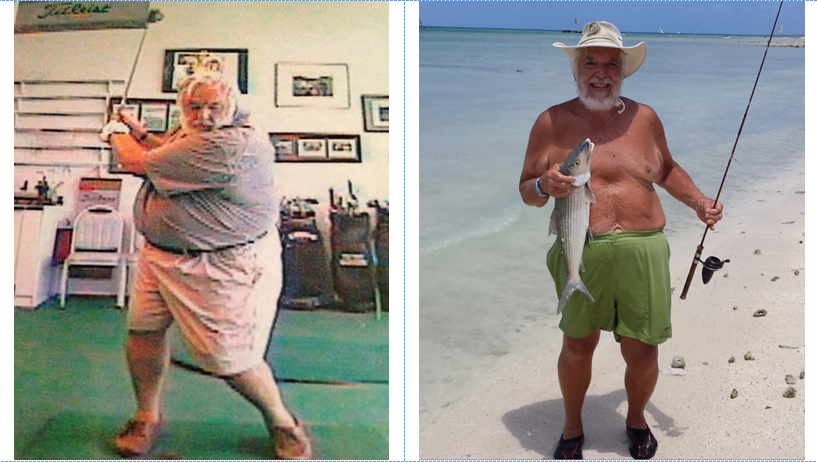
It strikes me as odd that the axiom, “A picture is worth a thousand words,” is barely a hundred years old. It is not surprising, though, that it is attributed to a newspaper editor. As overworked and hackneyed as it is, it is nevertheless true, as these pictures, taken before and after a few years of Very Low Carb eating, testify.


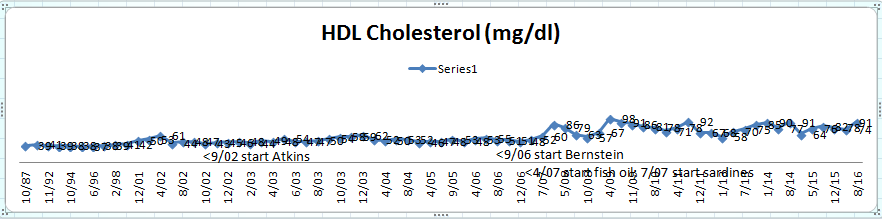
Equally persuasive are simple line charts, with values, as these two, which show respectively my HDL-C and my triglycerides over 35 years, the last 14 of which (2002-2016) were driven by my Very Low Carb Way of Eating.


Lest any doubt remain, this next chart shows that my Total Cholesterol averages over the same time frame were stable, contrary to the perennial declamations of naysayers of the conventional medical persuasion.


Enlarge these charts and look at the numbers, before and after 2002, when I started to eat Very Low Carb.

Wednesday, February 5, 2020

Retrospective #354: Macro and Keto Ratios


While exploring the Very Low Carb world over the years, I became interested in the workings of both Macronutrient Ratios and Ketogenic Ratios. I started with the study of Macronutrient Ratios around 2006 when I thought that “counting carbs” was not enough. I added protein and then fat (and total calories) and adjusted them over the years to where I eventually settled on 75% fat, 20% protein and 5% carbs, on only 1,200 calories by mouth a day. This calculates to a ketogenic ratio of food by mouth of about 2.0. More on that later.
Of course, these Macronutrient ratios account for only ingested food – food and drink that I put in my mouth. But since I strive to eat so few carbs, when I am not eating too many carbs or too much fat (and protein), I am able to add to the calorie burn – when my body requires more to maintain energy balance and remain an active metabolism – by burning body fat. I know that, so long as I eat Very Low Carb, I will have access to these fat calories because my serum insulin levels remain fairly low because there is a correspondingly low level of glucose circulating from carbohydrate (and protein) restriction. I know that my body is not shutting down – or even slowing my metabolism down to compensate for the low calorie intake by mouth – because I feel “pumped” all the time.
This additional body fat burning would imply that my actual Macronutrient Ratios are higher than 75/20/5. It also would imply a higher Ketogenic Ratio, since only fat is being added to the equation, almost all in the numerator.
So, let’s do the numbers. If my daily food intake is 1,200 calories, and the Macronutrient Ratios for food by mouth are 75% fat, 20% protein and 5% carbs, my intake is composed of 100g of fat (900kcal), 60g of protein (240kcal) and 15g of carbs (60kcal). But if my metabolism stays up, that is, is not slowed down by the lower food intake – because the low carb intake allows my body access to its fat storesthen my actual fat contribution, at the cellular level where the nutrients are absorbed, is going to be much higher. How much higher, you ask?
That depends on my metabolic rate. How many calories does my body burn?  That would be the sum of my resting metabolism plus my activity level, when not slowed down by either calorie restriction or from blocked access to body fat stores.
Let’s say, for argument’s sake, that my metabolism chugs along at 2,550kcal/hr. If I am only taking in (by mouth) 100g of fat, 60g of protein and 15g of carbs (1,200kcal total), it is theoretically getting a contribution from body fat of 1,350kcal (2,550 – 1,200 = 1,350kcals), or another 150g of body fat (1,350kcal/9kcal/g = 150g). That substantially changes the Macronutrient Ratio at the cellular level, where the body is actually fed. Check out this chart:
Nutrition & Metabolism
kcal
   fat(g)
  pro(g)
       cho(g)
 k/g ratio
Intake orally (food my mouth)
1200
   100
  60
  15
 2.0
Intake at the cellular level
2550
   250
  60
  15
 3.5
The formula for ketogenic ratio is derived Wilder and Winter (1922):
K/G ratio = (0.9*FAT+0.46*PRO)/(0.1*FAT+0.54*PRO+1*CHO.) 3.5 is a solid ketogenic ratio.
N.B.: Ideally, I am only burning extra body fat – and sparing protein. My body will use the carbs that I ate, which are going to be oxidized first, when it needs to make glucose for those cells that do not have mitochondria and therefore lack the ability to make ATP. Plus, amino acids from digested protein, not taken up in circulation, will become glucose via gluconeogenesis in the liver. And, the liver will also make glucose from the glycerol backbones of catabolized triglycerides when body fat is broken down and burned. So, fundamentally, the body’s requirement for carbohydrates is zero.

Tuesday, February 4, 2020

Retrospective #353: Advice for a friend who is “pre-diabetic”

“I Just remembered. I didn’t answer your ‘other news’ question,” I emailed her back. Then, I continued:
“As you now realize, having just lost over 20 pounds just by eating “lower carb,” you are in a metabolic balancing act 1) to control your genetic predisposition to be Insulin Resistant (by eating fewer carbs -- to control both your blood sugar and blood insulin), 2) to maintain your weight loss, and 3) to do this without hunger. If you are successful, you will secure the reversal of the sliding scale you were on that was leading to your progressively worsening blood sugar control – even with medication – and to your eventual diagnosis as a full-blown Type 2 Diabetic.
“You learned that you could reverse your ‘pre-diabetes’ by managing your diet. You learned to do that because you ‘ate to the meter,’ testing your blood sugar before and after eating suspect foods (ALL carbohydrates!). Because you acted in time, your ‘pre-diabetes’ had not progressed to where you’d seriously damaged your pancreas and developed non-reversible Insulin Resistance (IR). If you continue to eat the way you have learned for the rest of your life, you should be alright. You really have no other choice, unless you’re willing to accept progressive worsening of your Insulin Resistance and, despite medical therapy (more pills and eventually injected insulin), developing the inevitable complications. If you do this now, you will be able to cheat more than someone like me who learned much too late. Your genetic predisposition -- to become a Type 2 -- has been checked in time, I think. Congratulations!
“With respect to your ‘hunger,’ there is of course the possibility that this may be something other than your body telling you that you need energy from eating something (e.g., “nervous eating,” #348). But if it is actually hunger, here's what I think: N.B., your body and mine are in different metabolic states, so what I am telling you now is my understanding of how the body’s mechanisms work for someone in your current ‘state.’ Because I eat Very Low Carb, my body is never hungry so long as I abstain from eating more than a minimum number of carbs. My body is always being fueled by FAT, in my case both dietary and body fat. Both are triglycerides and break down to fatty acids. I eat plenty of fat, and I have plenty of stored fat on my body. So, my metabolism is always running in high gear. I am pumped. And my blood sugars are stable. I can even cheat because by always keeping my blood sugar and blood insulin levels ‘low,’ and by taking 750mg of metformin twice a day, my insulin sensitivity has improved. That means when I cheat, the sugar in my blood is taken up and my fasting glucose returns to ‘my normal’ (90s) easily. 
“In your case, you want to stop losing weight (but maintain your weight loss), and continue to remain insulin sensitive, and avoid hunger. To do this you need to continue to eat Low Carb (to keep you blood insulin level low and thus preserve access to body fat, plus eat more fat! Body fat is now recognized as an active organ, not a static blob. As long as you keep energy going in and out of the fat organ, you will be a fat burner, with a stable blood sugar, not a sugar burner where your blood sugar in on a roller coaster (from carbs you eat) and your energy level rises and falls. In other words, you’ll be letting your body use either your body fat or ingested fat for energy (thus maintaining a high energy level, i.e. always feeling pumped like me, and keeping a stable blood sugar).
If you instead eat carbs with every meal (together with fat and protein), your blood sugar will fluctuate, even if it returns to "your normal" (low 100s) one or two hours after eating. Your metabolism is being fed in part by dietary carbs, so your blood insulin level (with incipient IR) never goes down. And as a consequence, your Insulin Resistance will continue to worsen. And because your body won’t have access to body fat, you’ll get signals from your body that you are hungry. It will tell you to eat something because the path to letting your body break down its own fat for energy is blocked by the constantly elevated blood insulin level.
“Your solution: Skip carbs altogether for one or two meals a day. Try limiting them only to supper, say, or breakfast if you must have that "chocolate cocktail" you seem to enjoy. Eat mostly fat and protein for energy, and eat carbs only One Meal a Day, or from time to time, or on special occasions, like making deadline. NOT every day at every meal!

Monday, February 3, 2020

Retrospective #352: If you’re a Type 2, DON’T READ THIS.

Metformin* is designed for cheaters, like me! By that I mean Metformin is designed to work, or works best, with a “load” or “carbohydrate challenge.” That is my hypothesis, which recently came to mind after a “test” or “experiment,” as a friend jokingly refers to it, in which I consumed a large quantity of carbs in a short time.
I have to admit my judgment was impaired. My wife and I had been indulging all afternoon with friends, and I’d had more than a little red wine. Then, after a light supper that my wife prepared, she “raided” the freezer, and while her back was turned, I snuck a taste of her ice cream. And then – she is so noble – to be sure that I ate no more, she finished the container. Later, when I snuck back to the kitchen, opened the freezer and discovered this, I found a new pint of Talenti Gelato (Hazel Nut Chocolate Chip) and ate half of it, about 50g of carbs.
And if that wasn’t bad enough, the next day was Sunday, my weekly comeuppance day. It’s the day my Excel program averages the previous week’s seven Fasting Blood Glucoses and records my week’s weight loss (or gain). But, lo and behold my FBG was only 98, up from 91mg/dl the day before. And the weekly average was 96, up from 94 the week before. Thus, my hypothesis: Metformin works best with a carbohydrate challenge.
So, if Metformin is so effective at improving glucose uptake when presented with a big carb load, like a 50g slug, what incentive is there to not indulge now and then? I mean, we all cheat from time to time, right?
Well, I didn’t test my blood sugar post gelato, but considering it’s been 34 years since I was first diagnosed a Type 2, I can only imagine the rise that my blood sugar and blood insulin levels took in the immediate aftermath of that slug of sugar. It had to be precipitous, taking me well into the over 140mg/dl danger zone where damage is done to my organs. And it certainly took me out of a mild state of ketosis.
My weight the next morning was only a pound more than the day before, but how long, I wondered, would it be before the new glycogen stores were used up and my water weight dropped again. And how long would it be before my blood insulin level dropped, the bloat was gone, and I had that lean, high-energy feeling again.
Was it worth it? Probably not. But was it avoidable? For some, the answer apparently is “yes,”, or so I’m told by readers who profess not to be tempted. But then they may be people to whom temptation is not often presented – people who either live alone or with someone who is also attempting to eat Very Low Carb. In these households there IS no ice cream in the freezer. I am also definitely tempted by visual stimuli, or a lack of will to resist a visual stimulus. Or maybe it’s just a case of “arrested development” from a dysfunctional adolescence. Who knows? Everyone, as non-compliant folks are prone to rationalize, is different. That’s convenient!

*  My current Metformin regimen (upped in 2016 from 500mg/d), is 1500mg/d, divided between AM and PM. That’s the only anti-diabetic medication that I have taken since I started to eat Very Low Carb (…most of the time, lol) in 2002. I am experimenting with the larger dose since reading recently that Metformin is really effective only at higher doses. Unfortunately, I cannot find that reference.
I had also observed at a Metabolic Therapeutics conference that I attended in January 2016 that a large cohort of normoglycemic men, specifically fitness and training experts, including some body builders, were taking maximum doses of metformin (2000mg/day) to enhance glucose uptake and suppress unwanted gluconeogenesis. They want to facilitate ketogenesis to break down body fat, enabling them to reduce stored body fat and, by rigorous exercise, build muscle. Metformin has several known mechanisms of action, no side effects, and, in general, is well tolerated. 

Sunday, February 2, 2020

Retrospective #351: Am I still a Type 2 Diabetic?

Note: If you are asking the question, “Am I a type 2 diabetic,” look at “How Diabetic Do You Want to Be? Part 1” (#344 and “…Part 2” (#345). But read on if you are interested in a short essay on the subject “Am I still a Type 2 Diabetic?” The answer depends on whom you ask.
First, you need some “history.” I was diagnosed a Type 2 in 1986, before the A1c test was developed and the standard test was fasting blood glucose on two consecutive office visits of ≥140mg/dl. That standard changed to ≥126mg/dl in 1997, and the ADA adopted the hemoglobin A1c test to replace the FBG in 2002.
In 1986 my doctor started me out on the only anti-diabetic oral medication then available in the U.S. at the time, a sulfonylurea (SU), Micronase (generic: Glyburide). No doubt he advised me to lose weight (I was obese), but instead I gained. I do not recall if he gave me any dietary advice, but if he did, it would have been to follow the ADA, AMA and AHA Standard of Care: The Dietary Guidelines for Americans, issued every 5 years 1980, latest edition 2015.
When Metformin (in use in Europe since the mid ‘50s) was permitted in the U.S. in 1995, and I was maxed out on the SU, my doctor started me on that too. And when in a few years I was maxed out on Met, he started me on a 3rd class of oral drugs, the TZDs. I was then at my heaviest weight, and in yet another effort to get me to lose, my new doctor suggested I try a Very Low Carb diet he had read about in The New York Times. It was 20g of carbohydrates a day) as described by award-winning science writer Gary Taubes in the NYT Sunday Magazine cover story, “What If It’s All Been a Big Fat Lie?” It created quite a stir. He tried it and it worked. I tried it and, over time, lost 170 pounds.
Strictly eating no more that 20g of carbs a day, from the first day, to prevent hypoglycemia (low blood sugars) I had to give up first the Avandia (the TZD), then cut the other two meds in half, and then cut them in half again. A while later, I gave up the SU (glyburide) altogether and continued on 500mg Metformin once a day for the next 14 years.
In addition, in no time at all my lipids (cholesterol) improved dramatically. My HDL average more than doubled (39 to 81), my triglyceride average plummeted by 2/3rds (from 137 to 49), and even my LDL came down! And with all the weight lost my blood pressure improved substantially (on the same and then fewer meds). All these changes were from diet alone. NO EXERCISE.
So, am I still a Type 2 Diabetic? A clinician who looked at my fasting blood glucose (90mg/dl) would say, “Consistent with the absence of diabetes.” Yet, 30 years ago I was diagnosed a Type 2. Was it a mistake? Am I still a Type 2 Diabetic? Or, has my Type 2 Diabetes been “cured” because my “symptom” (high blood sugar) has gone away.
A clinician who looked at my hemoglobin A1c would see 5.7% and say, “Consistent with an increased risk for diabetes (prediabetes).” They would have no basis to conclude otherwise. They’d say, “We’ll continue to monitor that” (until it gets worse), and then maybe they’d write a script for a minimum dose of Metformin.
An endocrinologist would order a 2-hr Oral Glucose Tolerance Test (OGTT) in a hospital outpatient setting. It would reveal the underlying Impaired Glucose Tolerance (IGT). Result: Definitely, Type 2 Diabetic.
The truth: Starting probably 40 years ago, I gradually developed Insulin Resistance. I became Carbohydrate Intolerant. Insulin receptors on the surface of muscle, that are supposed to “open the door” to allow glucose to be taken up, started to gradually fail. My pancreas made more insulin. With overuse, its capacity to make beta cells began to wear out. That loss of function is not going to change. It’s not reversible, but my Type 2 Diabetes is TREATABLE, by making my insulin receptors work better. The only treatment that works for that underlying metabolic dysfunction (Insulin Resistance) is a low carbohydrate diet. THIS TREATMENT WORKS!
Eating Low Carb or Very Low Carb not as hard as you might think. After a few days, you lose your sense of hunger because your body has started to access and break down body fat for energy. It’s good energy. You feel alert. Pumped, actually. You don’t get sleepy after lunch. Your energy level is constant – no peaks and crashes – and you feel lean. You’re ready to hunt.

Saturday, February 1, 2020

Retrospective #350: My latest lipid panel (cholesterol test)

I realize that no one (besides me and my doctor) is interested in my latest cholesterol test, but…I write about it because I think it can be used to impart a wider message – a lesson really – on the effect that diet can have on the health markers the medical establishment considers important. Doctors don’t really know much about nutrition, and if they follow the “Standard of Care” and the “Dietary Guidelines,”,well…you’d be well advised not to follow that dietary advice. Doctors do like a good lipid panel though, so, what dietary advice produces good a cholesterol test?
My doctor scribbled “good” next to my latest lipid panel. I think, and I think he thought, it was better than good; it was stellar! Total Cholesterol: 184, HDL Cholesterol: 91; Cholesterol/HDL ratio: 2.0; LDL Cholesterol (calculated): 84; and Triglycerides: 46. To these, I always add the TG/HDL ratio, considered by some clinicians today to be "...the strongest predictor of a heart attack." My TG/HCL ratio is 46/91 or 0.5, nothing less than outstanding! 
In response, some (like my wife) will say, “Well, it’s genetic,” and “you’ve always had a ‘low cholesterol’” (i.e. Total Cholesterol). That is the value that most people (and their doctors) remember. It’s not true, in my case (as I’ll point out later), but, apart from that, why is it that most doctors only treat a high Total Cholesterol?
The answer is because most people who eat a Standard American Diet will have a borderline HDL (40mg/dl for men and 50mg/dl for women). They will also probably have borderline Triglycerides (near 150mg/dl). That leaves only LDL (and Total Cholesterol), and guess what? While doctors don’t have a magic pill to treat borderline HDL and borderline triglycerides, they do have drugs to lower LDL, and thus Total Cholesterol). They’re called STATINS.
So, if your “cholesterol” isn’t so good, your doctor will likely prescribe a statin for you. If you take it, and tolerate it without harsh side effects, be assured: statins will lower both your LDL cholesterol and your Total Cholesterol. The Friedewald equation explains why: TC = LDL + HDL + TG/5. Lowering your LDL and will lower your TC! And you will then be in good standing with your doctor (and his or her government overseers), because there’s not much more THEY can do.
But what about ...the strongest predictor of a heart attack, the TG/HDL ratio? Only diet can transform TG and HDL, and fix them good! I eat a Very Low Carb diet and practice Intermittent Fasting. I do it to keep my blood sugar low and stable, to therefore keep my serum insulin level low as well, and THUS burn body fat to lose weight.
I originally went on a Very Low Carb diet (20g/day) just to lose weight. We – both my doctor and I – were surprised to see that it had an immediate and very dramatic effect on my long-standing (16-year) Type 2 Diabetes. To avoid hypoglycemic events (“hypos”), I had to immediately (the very 1st day and week) stop taking the oral diabetes medications I had been prescribed over many years. I had been maxed out on 2 classes of meds and was starting a 3rd.  Afterwards, I was left with only a small dose of Metformin which I continued for 14 years.
But the other effect that neither my doctor nor I expected was that my HDL Cholesterol more than doubled (from 39 to 81mg/dl average) and my triglycerides dropped by 2/3s from 137 to 49mg/dl average. And this remarkable change continues to this day, as my most recent lipid panel (HDL = 91 and TG = 46) demonstrates. Of course, as I lost weight my blood pressure improved (on the same and then fewer meds) from 140/90 to 110/70. The most recent was 120/75 (I regained 35 of the 170 pounds initially lost.) And my inflammation marker, the hsCRP, a reliable “risk factor” for a constellation of morbid outcomes, is now almost always <1.0.
SO, WHAT DIFFERENCE DOES DIET MAKE? I ATTRIBUTE ALL OF THESE CHANGES TO DIET, A VERY LOW CARB DIET. My Type 2 diabetes is in remission, my lipids (cholesterol) are “good” or “stellar,” depending on whose interpretation, my blood pressure is well controlled, and my chronic systemic inflammation is indiscernible. Even my LDL is excellent (84mg/dl vs. <130mg/dl reference range, or “<100mg/dl for patients with CHD or diabetes.” And I did it all without a statin. You can too, but you have to be willing to TREAT YOURSELF, and CHANGE YOUR DIET.